In brief
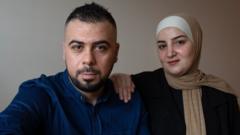
"Douna Haj Ahmed learns about her husband Abdullah Al Nofal's traumatic past in Al-Khatib prison, a revelation that allows them to process their experiences and speak out for the countless who cannot, highlighting the ongoing plight of Syrian refugees."
In early December, while watching news coverage of prisoners escaping the brutal regime of Bashar al-Assad, refugee Douna Haj Ahmed was confronted with a painful revelation: her husband, Abdullah Al Nofal, had been detained in the notorious Al-Khatib prison, a place infamous for its terror and torture. Sitting beside her, Abdullah pointed to the screen, sharing that he had been arrested at that very location.Douna, whose brothers also faced arrest during Syria's troubled civil war, had previously sensed her husband's traumatic history but had never heard the full details. "Abdullah prefers to present himself as strong," she stated, reflecting on the emotional turning point they experienced as her husband shared his vulnerability. This moment of disclosure marked a significant shift, as Abdullah expressed a desire for the world to understand the suffering endured by Syrians.His journey began in July 2013 when he was randomly stopped at a checkpoint in Damascus while working as a storekeeper for the International Committee of the Red Cross. He had previously participated in peaceful protests in 2011 but distanced himself from the escalating violence.At the checkpoint, Abdullah was handcuffed and blindfolded before being transported to a military area. He described an agonizing three-day solitary confinement, fearing for his life in complete darkness. Eventually, he was transferred to Al-Khatib, which housed an appalling 130 detainees, where he witnessed unimaginable horrors.According to reports from the Syrian Observatory for Human Rights, up to 60,000 individuals suffered torture and death while detained under the Assad regime. Notably, a trial in Germany recently found a Syrian colonel guilty of crimes against humanity at Al-Khatib, revealing testimonies of brutal torture methods that included sexual violence and beatings.Abdullah recounted the incessant screams of fellow detainees and the bloodshed that surrounded him. Diseases were rampant, with some inmates succumbing in desperation, their suffering a daily backdrop to his torment. After twelve torturous days, he faced interrogation, where he was beaten and coerced to claim false accusations against him.He cleverly crafted a fabricated narrative to avoid further punishment, ultimately leading to his release after thirty harrowing days. In the years following his escape from Syria, Abdullah achieved educational success, receiving scholarships that eventually brought him and Douna to London.Now, Abdullah feels liberated enough to recount his story, expressing gratitude for their newfound freedom. "We can testify now; we can tell the full story," he affirmed, reflecting on their privilege to share their experiences when so many remain unheard. Douna, a passionate human rights activist, broke down in tears as she absorbed the reality of her husband's ordeal for the first time, recognizing that the extent of torment under the Assad regime was even greater than she had imagined. "We must tell these stories. Many have perished without being heard," she lamented.As they continue to heal, Douna and Abdullah are committed to raising awareness of the plight of Syrian refugees, ensuring that the experiences of the many do not fade into the shadows of history.