In brief
Russian officials have pivoted their focus towards the suffering of Soviet citizens during WWII, contrasting with the global spotlight on Holocaust commemorations. While the country acknowledges the Holocaust, the emphasis has shifted towards portraying Russians as victims of the war, igniting debates on historical memory and the implications of this narrative amidst rising nationalism.
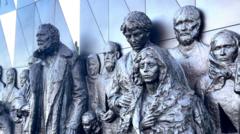
In a dramatic shift in narrative, Russia is spotlighting the suffering of Soviet civilians during World War II while downplaying the Holocaust's significance, coinciding with the 80th anniversary of Auschwitz's liberation. This reorientation is epitomized by the memorial unveiled in St. Petersburg, dedicated to “Soviet civilians who fell victim to the Nazi genocide.” The imposing monument, featuring a figure of a mother with her children, highlights real stories of human suffering while invoking names of notorious extermination camps like Auschwitz, Sobibor, and Treblinka. On January 27, a date of immense historical resonance for Russia, President Vladimir Putin inaugurated the memorial—a date also recognized as International Holocaust Remembrance Day. While the Kremlin has not ignored the Holocaust entirely, recent statements reflect a growing emphasis on the collective suffering of the Soviet people, lessening the specific focus on the genocide of the Jewish community. Historically, discussions regarding the Holocaust were scarce in the Soviet Union, with only a few memorials acknowledging Jewish victims. However, as attitudes shifted post-Communism, Russian officials began to openly celebrate their role in the Allies' victory against Nazism. Today, while Holocaust-related observances continue, Kremlin narratives seem to favor portraying Russians as war victims, aligning with a broader narrative of victimhood amid deteriorating relations with the West, particularly after the Ukraine invasion.Israel's Ambassador to Moscow, Simone Halperin, articulated concerns regarding this narrative shift, emphasizing that the Holocaust represented an industrialized genocide targeting Jews. Similarly, historian Konstantin Pakhaliuk argued that the Russian leadership's focus on Soviet suffering serves to position the nation as a victim in contemporary geopolitical dynamics.Despite the escalating tension between Russian and Western nations, notable figures like Rabbi Alexander Boroda have voiced that the exclusion of Russia from commemorative events is a disservice to the multifaceted history of WWII. As anti-Semitism resurges and Holocaust denial proliferates, Jewish leaders and organizations in Russia stress the importance of awareness in preventing the repetition of past atrocities. Anna Bokshitskaya, of the Russian Jewish Congress, highlighted the crucial mission to educate younger generations about the Holocaust, regardless of the contemporary narratives emerging in Russian society.