For months, US spies had been monitoring Venezuelan President Nicolas Maduro's every move. A small team, including one source within the Venezuelan government, had been observing where the 63-year-old slept, what he ate, what he wore and even, according to top military officials, 'his pets'.
Then, in early December, a planned mission dubbed 'Operation Absolute Resolve' was finalised. It was the result of months of meticulous planning and rehearsals, which even included elite US troops creating an exact full-size replica of Maduro's Caracas safe house to practise their entry routes.
The plan - which amounted to an extraordinary US military intervention in Latin America not seen since the Cold War - was closely guarded. Congress was not informed or consulted ahead of time. With the precise details set, top military officials simply had to wait for the optimal conditions to launch.
They wanted to maximise the element of surprise, officials said on Saturday. There was a false start four days earlier when US President Donald Trump gave approval, but they opted to wait for better weather and less cloud cover.
'Over the weeks through Christmas and New Year, the men and women of the United States military sat ready, patiently waiting for the right triggers to be met and the president to order us into action,' General Dan Caine, the nation's highest-ranking military officer, told a news conference on Saturday morning.
The order from the president to begin the mission finally came at 22:46 EST on Friday (03:46 GMT on Saturday). 'We were going to do this four days ago, three days ago, two days ago, and then all of a sudden it opened up. And we said: go,' Trump himself told Fox & Friends on Saturday, hours after the overnight raid.
'He said to us, and we appreciate it... good luck and godspeed,' Gen Caine said. Trump's order came shortly before midnight in Caracas, giving the military most of the night to operate in darkness.
What followed was a two-hour-and-twenty-minute mission by air, land and sea that stunned many in Washington and around the world. In terms of scale and precision, it was virtually unprecedented. And it drew immediate condemnation from several regional powers, with Brazil's President Lula da Silva saying the violent capture of Venezuela's leader set 'yet another extremely dangerous precedent for the entire international community'.
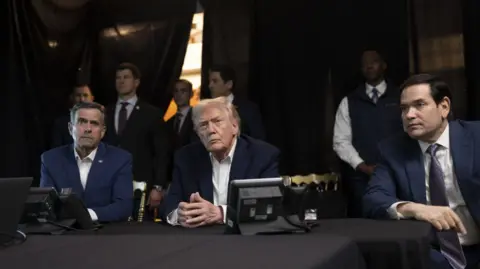
Trump did not follow the mission from the White House situation room. Instead, he was surrounded by his advisers at his Mar-a-Lago club in Palm Beach, Florida, where he watched a live stream of the operation flanked by CIA Director John Ratcliffe and US Secretary of State Marco Rubio.
'It was an incredible thing to see,' Trump said on Saturday. 'If you would have seen what happened, I mean, I watched it literally like I was watching a television show. And if you would've seen the speed, the violence... it's just, it was an amazing thing, an amazing job that these people did.'
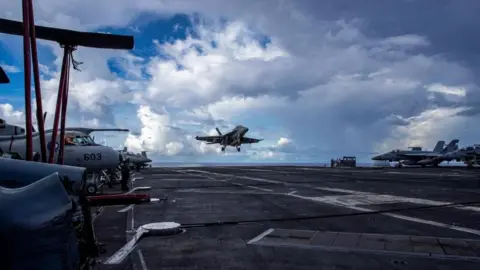
In recent months, thousands of US troops have deployed to the region, joining an aircraft carrier and dozens of warships in the largest military build-up in decades as Trump has accused Maduro of drug-trafficking and narco-terrorism, and blown up dozens of small boats accused of ferrying drugs through the region.
But the first signs of Operation Absolute Resolve were in the skies. More than 150 aircraft - including bombers, fighter jets and reconnaissance planes - were ultimately deployed through the course of the night, according to US officials.
'Loud explosions were heard in Caracas at about 02:00 local time (06:00 GMT), and plumes of smoke were seen rising over the city. I heard a huge sound, a loud bang,' reporter Ana Vanessa Herrero told the BBC. 'It moved all the windows. Immediately after I saw a huge cloud of smoke that almost blocked the entire view.'
As strikes rang out around Caracas, US forces made their way into the city, including members of the elite Delta Force, heavily armed and carrying a blowtorch in case they had to cut through the metal doors of Maduro's safe house.
Once the mission began, ongoing assessments and immediate responses unfolded to secure the location and apprehend Maduro and his wife, Cilia Flores, amidst complex military operations and extensive territorial controls.
The operation concluded with Maduro and his wife captured and en route to face justice in the United States, amid widespread discussions about the geopolitical implications of this unprecedented action.
Then, in early December, a planned mission dubbed 'Operation Absolute Resolve' was finalised. It was the result of months of meticulous planning and rehearsals, which even included elite US troops creating an exact full-size replica of Maduro's Caracas safe house to practise their entry routes.
The plan - which amounted to an extraordinary US military intervention in Latin America not seen since the Cold War - was closely guarded. Congress was not informed or consulted ahead of time. With the precise details set, top military officials simply had to wait for the optimal conditions to launch.
They wanted to maximise the element of surprise, officials said on Saturday. There was a false start four days earlier when US President Donald Trump gave approval, but they opted to wait for better weather and less cloud cover.
'Over the weeks through Christmas and New Year, the men and women of the United States military sat ready, patiently waiting for the right triggers to be met and the president to order us into action,' General Dan Caine, the nation's highest-ranking military officer, told a news conference on Saturday morning.
The order from the president to begin the mission finally came at 22:46 EST on Friday (03:46 GMT on Saturday). 'We were going to do this four days ago, three days ago, two days ago, and then all of a sudden it opened up. And we said: go,' Trump himself told Fox & Friends on Saturday, hours after the overnight raid.
'He said to us, and we appreciate it... good luck and godspeed,' Gen Caine said. Trump's order came shortly before midnight in Caracas, giving the military most of the night to operate in darkness.
What followed was a two-hour-and-twenty-minute mission by air, land and sea that stunned many in Washington and around the world. In terms of scale and precision, it was virtually unprecedented. And it drew immediate condemnation from several regional powers, with Brazil's President Lula da Silva saying the violent capture of Venezuela's leader set 'yet another extremely dangerous precedent for the entire international community'.
Trump did not follow the mission from the White House situation room. Instead, he was surrounded by his advisers at his Mar-a-Lago club in Palm Beach, Florida, where he watched a live stream of the operation flanked by CIA Director John Ratcliffe and US Secretary of State Marco Rubio.
'It was an incredible thing to see,' Trump said on Saturday. 'If you would have seen what happened, I mean, I watched it literally like I was watching a television show. And if you would've seen the speed, the violence... it's just, it was an amazing thing, an amazing job that these people did.'
In recent months, thousands of US troops have deployed to the region, joining an aircraft carrier and dozens of warships in the largest military build-up in decades as Trump has accused Maduro of drug-trafficking and narco-terrorism, and blown up dozens of small boats accused of ferrying drugs through the region.
But the first signs of Operation Absolute Resolve were in the skies. More than 150 aircraft - including bombers, fighter jets and reconnaissance planes - were ultimately deployed through the course of the night, according to US officials.
'Loud explosions were heard in Caracas at about 02:00 local time (06:00 GMT), and plumes of smoke were seen rising over the city. I heard a huge sound, a loud bang,' reporter Ana Vanessa Herrero told the BBC. 'It moved all the windows. Immediately after I saw a huge cloud of smoke that almost blocked the entire view.'
As strikes rang out around Caracas, US forces made their way into the city, including members of the elite Delta Force, heavily armed and carrying a blowtorch in case they had to cut through the metal doors of Maduro's safe house.
Once the mission began, ongoing assessments and immediate responses unfolded to secure the location and apprehend Maduro and his wife, Cilia Flores, amidst complex military operations and extensive territorial controls.
The operation concluded with Maduro and his wife captured and en route to face justice in the United States, amid widespread discussions about the geopolitical implications of this unprecedented action.