In brief
Recent developments have revealed a significant deepening of military ties between Russia and Iran, marking a critical shift in their bilateral relations.
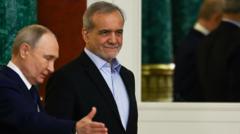
In a noteworthy move, Russian President Vladimir Putin and Iranian President Masoud Pezeshkian formalized a 20-year "strategic partnership" treaty during Pezeshkian's recent visit to Moscow. This agreement encompasses various sectors, emphasizing defense, technology, energy, and trade, and signifies a noteworthy strengthening of military cooperation between the two nations.The treaty reaffirms Iran's existing role in supplying drones and, as reported by Western intelligence, ballistic missiles to Russia amidst the backdrop of intensified geopolitical tensions since Russia's invasion of Ukraine in February 2022. By committing to consult and collaborate on military and security issues, the two countries aim to forge a united front against perceived threats. The agreement also stipulates that neither nation will permit its territory to be utilized for hostile actions against the other.During a joint news conference, Pezeshkian heralded the signing of the treaty as the commencement of a transformative phase for Russia-Iran relations. Enhanced trade opportunities are anticipated as both countries explore cooperation within the energy domain. Notably, Putin expressed interest in building new nuclear power units in Iran, while also seeking to market surplus gas to Tehran—a critical consideration given the European Union's reduced gas imports from Russia following the onset of the Ukrainian conflict.Adding another layer to their partnership, the two nations are negotiating the establishment of a gas pipeline from Russia to Iran, which would traverse Azerbaijan. Should this initiative come to fruition, it could enable Russia to supply up to 55 billion cubic meters of gas annually to Iran, thereby solidifying an economically significant relationship between the two nations, as highlighted by Russian Energy Minister Sergei Tsivilev.