In brief
Min Aung Hlaing's visit underscores a complex diplomatic relationship as China seeks stability and economic continuity in Myanmar despite escalating insurgencies.
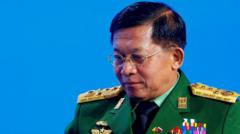
Myanmar's military leader, Min Aung Hlaing, has embarked on his first visit to China since ousting Aung San Suu Kyi's elected government in February 2021. This visit comes at a critical juncture as his regime faces mounting pressures from poorly-armed insurgents in an ongoing civil war. Despite his deeply controversial leadership and the brutal civil unrest that has marred his governance, the invitation to China—Myanmar's largest trading partner—highlights Beijing's strategic interest in maintaining ties.Arriving in Kunming, Yunnan province, Min Aung Hlaing is leading a delegation composed of officials and business figures to attend a minor summit of the Greater Mekong Sub-region. This meeting is emblematic of his diplomatic isolation since the coup, as regional gatherings often exclude him. Historically, his overseas engagements have been limited, with Russia being the only other notable destination. During the Kunming summit, he is expected to have discussions with Chinese Premier Li Qiang. However, the gathering is primarily characterized by the presence of leaders from neighboring authoritarian regimes—an indication of its lower diplomatic significance. China, cautious about the implications of Min Aung Hlaing’s participation, is keenly aware of the shifting dynamics. Over the past year, there has been speculation that Beijing could distance itself from the Myanmar junta due to the escalating civil war’s ramifications. The ethnic insurgents, some of whom operate along the Chinese border, have notably targeted scam centers impacting many Chinese nationals. This led to assumptions that Beijing might have tacitly supported insurgent actions against the junta.In recent months, however, China has sought to stabilize the situation by encouraging Min Aung Hlaing to outline a potential timetable for returning to structured elections. The overarching aim of this alignment is to restore cross-border trade and to safeguard extensive Chinese investments within Myanmar.Opposition groups in Myanmar, notably the National Unity Government (NUG) representing the ousted leadership, criticize China's overtures toward the junta. They express concerns regarding the normalization of relations that could undermine efforts to establish a genuine democratic framework. NUG spokesperson Kyaw Zaw articulates the sentiments shared among opposition factions, emphasizing the populace’s aspirations for peace and stability—elements they hold the junta responsible for destroying. While this resistance remains potent, the opposition faces significant challenges in overarching military dynamics. For China, the specter of an unstable Myanmar presents a concern, as it fears a potential power vacuum could breed further chaos with various factions vying for control. Despite the junta's troubling human rights track record and governance failures, China appears poised to maintain its partnership, recognizing that stability within Myanmar is paramount to its economic interests and regional influence.At present, as Western diplomatic influence wanes and India's presence focuses on localized grievances, China is uniquely positioned to engage meaningfully in crisis resolution. With significant financial investments made towards trade routes within Myanmar, the country continues to be an important factor in regional geopolitics, compelling China to navigate its relationship with the military regime carefully.