
In brief
The US President's remarks about 'resettling' Palestinians could be seen as a violation of international law and a call for ethnic cleansing.
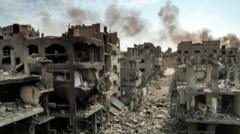
In recent remarks, US President Donald Trump has put forth a controversial plan regarding Gaza, suggesting it should be regarded as a "demolition site." This plan, initially perceived as casual remarks, is now being recognized as a serious departure from established US policies on the Israeli-Palestinian conflict. The implications of Trump's proposal raise significant concerns about compliance with international law, specifically in relation to the forced resettlement of Palestinians.Trump's call to "permanently resettle" Palestinians out of Gaza, which he framed as a humanitarian necessity, is facing immediate backlash. Under international law, forcibly transferring populations is strictly forbidden. Arab nations and Palestinian representatives view these statements as a direct threat aimed at the ethnic cleansing of Palestinians from their homeland.Response to Trump’s suggestions has been swift and condemnatory. A coalition of Arab states—including Egypt, Saudi Arabia, and the Palestinian Authority—has publicly rejected the plan, articulating that such actions would destabilize the region further, exacerbate the conflict, and hinder any aspirations for peace.The ultranationalist factions within Israel, who have historically pushed for the expansion of Jewish settlements and the removal of Palestinians, have received Trump's statements with enthusiasm. Following the attacks on Israel on October 7, there have been renewed calls from these groups for prolonged military engagement against Hamas, with a focus on re-establishing settlements in Gaza.In a press conference with Israeli Prime Minister Benjamin Netanyahu, Trump escalated his rhetoric further, stating that the US could take ownership of the Gaza Strip and proceed to rebuild it, envisioning it as the "Riviera of the Middle East." When questioned about the return of Palestinians, Trump implied that the area would ultimately be open to all, albeit in his vision, overshadowing the rights of the existing population.Trump's proposed framework would drastically alter the longstanding US stance on the region, essentially undermining the concept of a two-state solution. Such actions threaten the livelihoods of over two million Palestinians, a majority of whom are descendants of those who were forced to flee or were displaced during the earlier conflicts surrounding the establishment of Israel.The consequences of these proposals are far-reaching, likely to be perceived by ordinary Palestinians as an act of mass punishment and further isolation. As the situation unfolds, the implications of these radical proposals resonate deeply, raising urgent questions about international law, human rights, and the future of an already beleaguered population.


