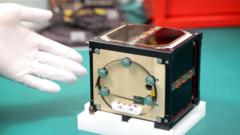
In a groundbreaking development, researchers from Kyoto University have launched the world's first wood-panelled satellite, LignoSat, into space. This innovative satellite, which weighs only 900g, is designed to explore the potential of timber as a sustainable building material for future extraterrestrial explorations, particularly on the Moon and Mars. The satellite, made from magnolia wood and constructed using traditional techniques devoid of screws or glue, is currently en route to the International Space Station via a SpaceX mission, from where it will be deployed into orbit around Earth.
Professor Koji Murata, a forest science expert at Kyoto University, highlights the advantages of using wood in space: "Wood is more durable in space than on Earth because there's no water or oxygen that would rot or inflame it." Reflecting on the history of wooden aircraft built in the early 1900s, Prof Murata expressed optimism about the feasibility of wooden satellites, asserting that if trees could be cultivated on the Moon or Mars, they could serve as essential construction materials for future space colonies.
While LignoSat is primarily constructed from wood, it also includes traditional aluminum frameworks and electronic components, equipped with sensors to monitor how wood withstands the harsh conditions of outer space over its six-month mission. This approach aligns with a broader effort to utilize renewable resources in space technology. Dr. Simeon Barber, a UK-based space research scientist, noted the sustainability benefits of wood, emphasizing its renewable nature and potential for extraterrestrial habitats.
Historically, wood has already found applications in spacecraft, such as cork used in re-entry heat shields, illustrating its viability as a material in space-related endeavors. However, challenges remain, as Dr. Barber pointed out the difficulties associated with predicting the strength and stability of wooden structures, which complicates their use in critical spacecraft components.
As concerns grow over the environmental impact of space missions, researchers hope that incorporating wood could reduce pollution associated with the incineration of metallic spacecraft upon re-entry. While the potential for wooden satellites presents an intriguing alternative, experts caution that it may lead to increased weight, thereby impacting overall mission efficiency.
The development of LignoSat marks a significant step towards understanding sustainable materials for space exploration. This pioneering satellite sets the stage for future innovations that could lay the foundation for a greener approach to interplanetary colonization and exploration.