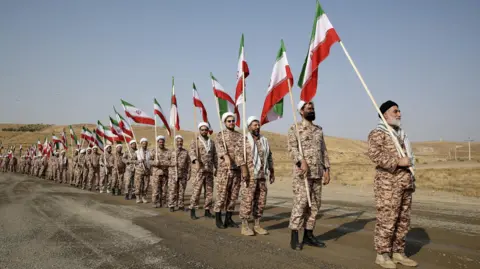
The European Union has added Iran's Islamic Revolutionary Guard Corps (IRGC) to its terrorist list in response to Tehran's deadly crackdown on protesters in recent weeks. The bloc's top diplomat Kaja Kallas stated that EU foreign ministers took this 'decisive step' because 'repression cannot go unanswered.' She emphasized that this move places the IRGC—a significant military, economic, and political force in Iran—on par with jihadist groups like al-Qaeda and the Islamic State.
Human rights organizations have estimated that thousands of protesters were killed by security forces, including the IRGC, during recent civil unrest that erupted in December and January. Kallas remarked in a social media statement that any regime that kills thousands of its own people is working towards its demise.
Updates from human rights watchdogs indicate an alarming count of over 6,300 fatalities, many of whom were peaceful protestors, as a result of the violence instigated by the IRGC and its affiliated forces.
The IRGC was established following the 1979 Iranian Revolution to safeguard the Islamic regime, and it reportedly has around 190,000 personnel. The EU's decision to classify the IRGC as a terrorist group is anticipated to lead to sanctions including travel bans and asset freezes, targeting senior officials and entities involved in the repression of dissent.
While nations like Australia, Canada, and the United States have already designated the IRGC as a terrorist organization, its classification remains unaddressed in the UK.
Recent developments have seen a strong international response to Iran's actions, with various governments emphasizing the need for accountability for the violence against protestors. This EU decision signals a significant diplomatic shift and underscores an increasing urgency to confront human rights abuses in Iran.
Human rights organizations have estimated that thousands of protesters were killed by security forces, including the IRGC, during recent civil unrest that erupted in December and January. Kallas remarked in a social media statement that any regime that kills thousands of its own people is working towards its demise.
Updates from human rights watchdogs indicate an alarming count of over 6,300 fatalities, many of whom were peaceful protestors, as a result of the violence instigated by the IRGC and its affiliated forces.
The IRGC was established following the 1979 Iranian Revolution to safeguard the Islamic regime, and it reportedly has around 190,000 personnel. The EU's decision to classify the IRGC as a terrorist group is anticipated to lead to sanctions including travel bans and asset freezes, targeting senior officials and entities involved in the repression of dissent.
While nations like Australia, Canada, and the United States have already designated the IRGC as a terrorist organization, its classification remains unaddressed in the UK.
Recent developments have seen a strong international response to Iran's actions, with various governments emphasizing the need for accountability for the violence against protestors. This EU decision signals a significant diplomatic shift and underscores an increasing urgency to confront human rights abuses in Iran.