A fracture in a straight section of track occurred prior to the passage of a high-speed train that derailed, causing last Sunday's rail disaster in which 45 people died, an initial report has found.
A train run by private company Iryo derailed last Sunday and its rear carriages crossed on to the opposite track into the path of an oncoming train run by state-owned Renfe.
The CIAF rail investigation commission said not only did Iryo train's front carriages which stayed on the track have notches in their wheels, but three earlier trains that went over the track earlier did too.
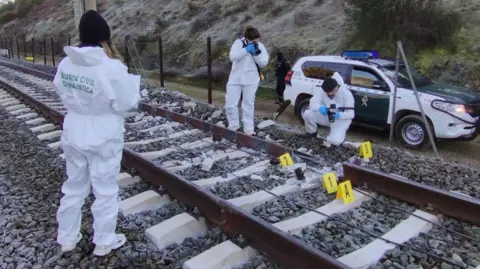
A gap of almost 40cm (15in) in the track has become the focus of the investigation into the crash.
Sunday's deadly collision occurred at around 19:45 local time (18:45 GMT), about an hour after the Iryo train left Málaga for Madrid.
The train's last three carriages - carriages six to eight - derailed and collided with the Huelva-bound Renfe train. Carriage six derailed due to a complete lack of continuity in the track, the preliminary report finds.
Most of those killed and injured were in the front carriages of the state-operated train.
Earlier this week, Spanish Transport Minister Óscar Puente confirmed that grooves were found on the wheels of the Iryo train's carriages, which had passed over the track safely. The CIAF preliminary report stated that these notches and observed deformities in the track are consistent with prior damage.
The report emphasized that three trains that traversed the tracks at various times just before the incident displayed similar notches, indicating systemic issues with the infrastructure.
The CIAF report remains a hypothesis pending further analysis and calculations. Transport Minister Puente cautioned that the fracture likely occurred shortly before the derailment, making it undetectable in standard checks.
The Adamuz disaster stands as the worst rail crash in Spain in over a decade, evoking memories of the 2013 Galicia train derailment that resulted in the deaths of 80 individuals.