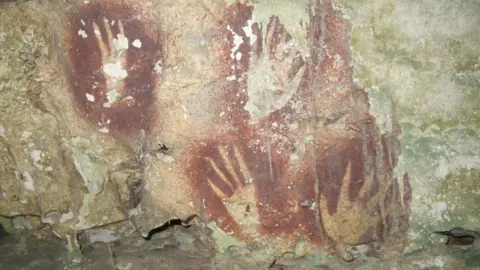
A stencilled outline of a hand found on the Indonesian island of Sulawesi is the world's oldest known cave painting, researchers say.
It shows a red outline of a hand whose fingers were reworked to create a claw-like motif, indicating an early leap in symbolic imagination. The painting has been dated to at least 67,800 years ago – around 1,100 years before the previous record, a controversial hand stencil in Spain.
This discovery strengthens the argument that Homo sapiens reached the wider Australia–New Guinea landmass, known as Sahul, at least 15,000 years earlier than some scholars suggest.
Recent findings from Sulawesi suggest that artistic expression and abstract thought in humans did not emerge suddenly in Ice Age Europe but were likely rooted in earlier cultures across the globe.
Cave art serves as a vital marker in understanding when humans began to think symbolically, a cognitive leap that is fundamental to language, religion, and science. Professor Adam Brumm of Griffiths University emphasized that this discovery adds to the growing understanding that creativity was intrinsic to our species, stretching back to our origins in Africa.
The recent discovery in a limestone cave called Liang Metanduno shows that the artist created a negative outline by spraying pigment around their hand. The meticulous alteration of the fingers into a claw-like shape indicates a sophisticated level of creativity.
After years of research, the age and significance of these cave paintings throughout Sulawesi bolster the argument of a continuous artistic tradition within ancient cultures, emphasizing their deep-rooted connection in expressing abstract thought.
As researchers continue to analyze and date these paintings, they highlight the indispensable narrative art contributed to defining human cultures across history, challenging the notion that symbolic art emerged primarily in Europe.