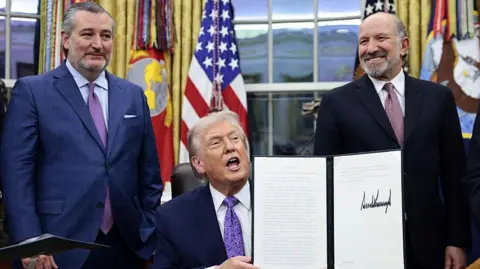
US President Donald Trump has signed an executive order aimed at blocking states from enforcing their own artificial intelligence (AI) regulations.
We want to have one central source of approval, Trump told reporters in the Oval Office on Thursday.
The order will provide the Trump administration with tools to combat what they deem the most onerous state rules, although regulations focusing on children's safety will remain untouched according to White House AI adviser David Sacks.
This decision marks a significant win for technology companies who have advocated for a unified federal stance on AI legislation amidst the fast-evolving industry landscape.
Bosses from AI companies have argued that the patchwork of state-level regulations could stifle innovation and impede the United States in its competition against China to lead in AI technology, with significant investments being put into the sector.
However, the announcement has sparked backlash. California, home to many technology giants, has its own set of AI regulations already in place.
Governor Gavin Newsom of California issued a staunch statement in response to the executive order, accusing Trump of corruption. He stated, Today, President Trump continued his ongoing grift in the White House, attempting to enrich himself and his associates, with a new executive order seeking to preempt state laws protecting Americans from unregulated AI technology.
Earlier this year, Newsom signed a law requiring major AI developers to establish plans to mitigate risks associated with their AI models.
Additionally, states like Colorado and New York have implemented their own AI regulations, setting a precedent for others to follow.
Newsom has posited that California's regulations could serve as a model for wider federal standards.
Critics of Trump's executive action argue that local laws are essential for consumer protection in the absence of federal regulations. Julie Scelfo from the advocacy group Mothers Against Media Addiction commented that the strip of state rights undermines the basic tenets of local governance and safety for residents.